patterns, types, type shifting patterns, composite patterns, globular patterns, large pixel art, colour rectangles, coloured square diagrams, short prose, poetry, abstract art, free thinking, inventor, original, number theory, tiling patterns, four regions of natural numbers, fuzzy thinking, Zen, yin yang philosophy, math art
Tuesday, 10 February 2015
Thursday, 5 February 2015
an easy folding pattern puzzle
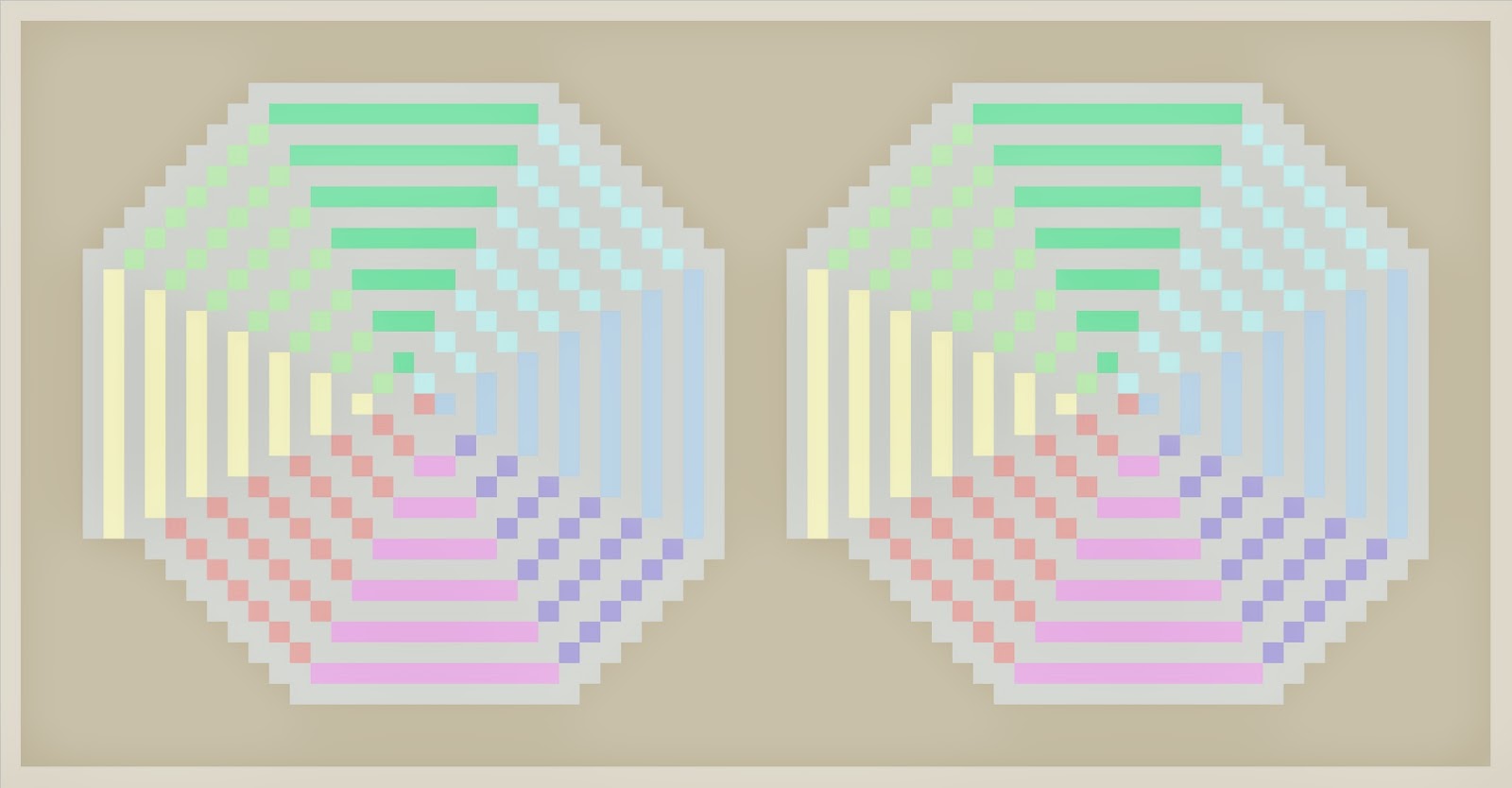
This is a representation of a Woodall number.
A Woodall number is any natural number of the form n*(2^n) - 1
for some natural number n. The first few Woodall numbers are: 1, 7, 23, 63, 159, 383, 895, … (sequence A003261 in OEIS). What is the Woodall number represented ?
A Woodall number is any natural number of the form n*(2^n) - 1
for some natural number n. The first few Woodall numbers are: 1, 7, 23, 63, 159, 383, 895, … (sequence A003261 in OEIS). What is the Woodall number represented ?
Friday, 23 January 2015
Monday, 19 January 2015
Thursday, 15 January 2015
turning the light on divisor chains
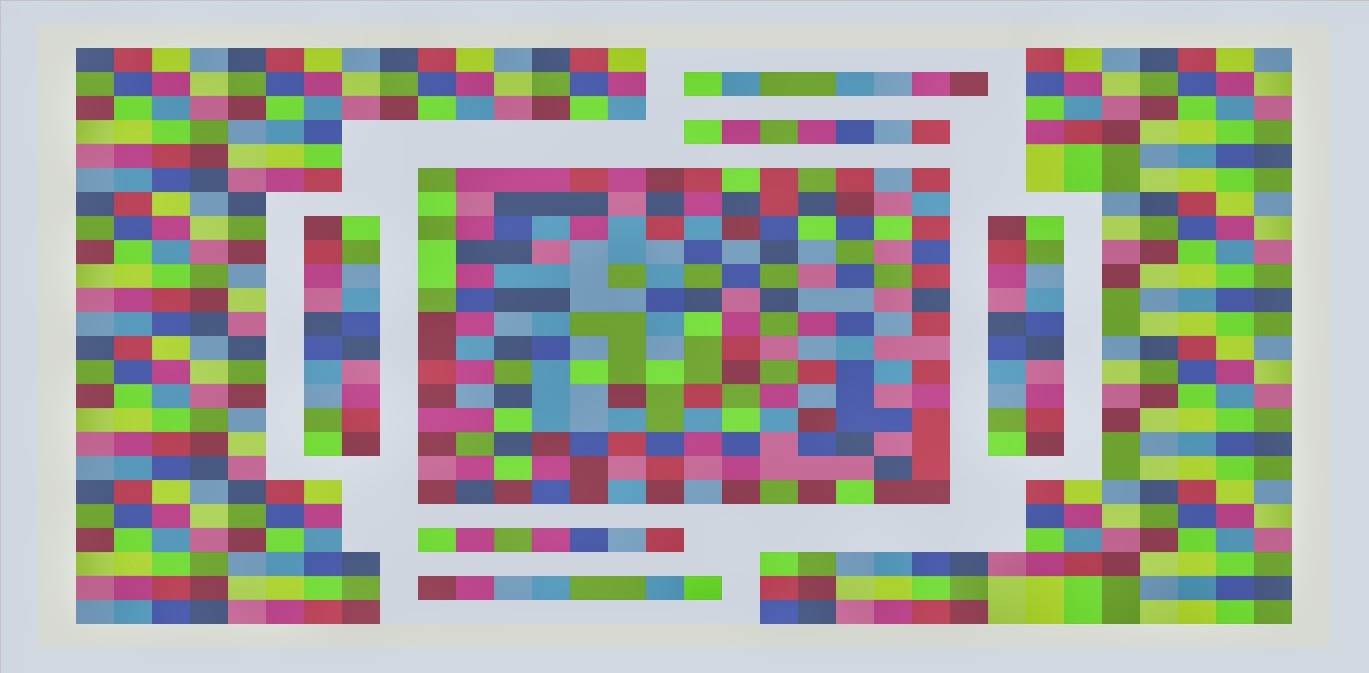
two similar art works based on the concept of divisor chains, a simple example to illustrate
start with a number, say 3. clearly 3 | 3 ( 3 divides 3 )
3, 1 is OK as 1 | (3+1) ;
3, 1, 2 is OK as 2 | (3+1+2) ;
3, 1, 2, 6 is OK as 6 | (3+1+2+6)
3, 1, 2, 6, 4 is OK as 4 | (3+1+2+6+4)
3, 1, 2, 6, 4, 8 is OK as 8 | (3+1+2+6+4+8)
the idea is to consider earliest ( smallest ) whole numbers not yet used
until we find a value is OK, satisfying the required property.
the sum is up to 24. at this stage, adding 5 isn't going to help, neither is adding 7, nor 9,
nor 10, nor 11, what about 12 ?
12 does the job nicely as 24 + 12 = 36 and 12 | (3+1+2+6+4+8+12)
the puzzle is to discover from the grouping and ordering of the coloured rectangles
what are the divisor chains represented from permutations of { 1, ..., n }
start with a number, say 3. clearly 3 | 3 ( 3 divides 3 )
3, 1 is OK as 1 | (3+1) ;
3, 1, 2 is OK as 2 | (3+1+2) ;
3, 1, 2, 6 is OK as 6 | (3+1+2+6)
3, 1, 2, 6, 4 is OK as 4 | (3+1+2+6+4)
3, 1, 2, 6, 4, 8 is OK as 8 | (3+1+2+6+4+8)
the idea is to consider earliest ( smallest ) whole numbers not yet used
until we find a value is OK, satisfying the required property.
the sum is up to 24. at this stage, adding 5 isn't going to help, neither is adding 7, nor 9,
nor 10, nor 11, what about 12 ?
12 does the job nicely as 24 + 12 = 36 and 12 | (3+1+2+6+4+8+12)
the puzzle is to discover from the grouping and ordering of the coloured rectangles
what are the divisor chains represented from permutations of { 1, ..., n }
Monday, 12 January 2015
Saturday, 10 January 2015
Thursday, 8 January 2015
Friday, 26 December 2014
Monday, 1 December 2014
Friday, 28 November 2014
Fairy Board
From the Fairy Board identify:
[1] The 2 ways to arrange 4 non-attacking kings on a 4 X 4 board with 1 in each row and column.
See Hertzsprung's problem: ways to arrange n non-attacking kings on an n X n board,
with 1 in each row and column (A002464)
[2] The 4 ways to place a non-attacking white and black rook on 2 X 2 chessboard.
See Number of ways to place a non-attacking white and black rook on n X n chessboard (A035287)
[3] One of the 4 ways to place 10 nonattacking superqueens on a 10 X 10 board.
See Number of ways of placing n nonattacking superqueens on an n X n board (A051223)
Tuesday, 25 November 2014
Polyknights and F3Layer2
Directional Contiguous Polyknights with 5, 6 and 7 moves, where a 1-move is a stationary knight
F3Layer2 is the pattern arising from applying 3 factorial
to 3 colours and then again to the 3 blocks of dimensions 2 by 3
Monday, 24 November 2014
Yellow Submarine
Free, one-sided, and fixed polyknights
There are three common ways of distinguishing polyominoes and polyknights
free polyknights are distinct when none is a rigid transformation ( translation, rotation, reflection or glide reflection ) of another ( pieces that can be picked up and flipped over ). one-sided polyknights are distinct when none is a translation or rotation of another ( pieces that cannot be flipped over ).
fixed polyknights are distinct when none is a translation of another ( pieces that can be neither flipped nor rotated ). Yellow submarine shows polyknights of various types with 2 cells.
There are three common ways of distinguishing polyominoes and polyknights
free polyknights are distinct when none is a rigid transformation ( translation, rotation, reflection or glide reflection ) of another ( pieces that can be picked up and flipped over ). one-sided polyknights are distinct when none is a translation or rotation of another ( pieces that cannot be flipped over ).
fixed polyknights are distinct when none is a translation of another ( pieces that can be neither flipped nor rotated ). Yellow submarine shows polyknights of various types with 2 cells.
Friday, 7 November 2014
Wednesday, 5 November 2014
Wednesday, 29 October 2014
Sunday, 26 October 2014
Friday, 24 October 2014
Monday, 6 October 2014
triples of perception
when looking at a sequence of symbols 3 numbers are perceptually present
00 we see 2 symbols and 1 adjacent pair and count 2 symbols from the adjacent pair
000 we see 3 symbols and 2 adjacent pairs and count 4 symbols from the adjacent pairs
0000 we see 4 symbols and 3 adjacent pairs and count 6 symbols from the adjacent pairs
00000 we see 5 symbols and 4 adjacent pairs and count 8 symbols from the adjacent pairs
000000 we see 6 symbols and 5 adjacent pairs and count 10 symbols from the adjacent pairs
0-n0s-0 we see n symbols and n-1 adjacent pairs and count 2(n-1) symbols from the adjacent pairs
so with a worked out example
00 we see 2 symbols and 1 adjacent pair and count 2 symbols from the adjacent pair
000 we see 3 symbols and 2 adjacent pairs and count 4 symbols from the adjacent pairs
0000 we see 4 symbols and 3 adjacent pairs and count 6 symbols from the adjacent pairs
00000 we see 5 symbols and 4 adjacent pairs and count 8 symbols from the adjacent pairs
000000 we see 6 symbols and 5 adjacent pairs and count 10 symbols from the adjacent pairs
0-n0s-0 we see n symbols and n-1 adjacent pairs and count 2(n-1) symbols from the adjacent pairs
so with a worked out example
how many numbers do we naturally see in oooo ??
oooo 4
oo oo oo 3
oooooo 6
or the numbers 12 and 13 used in musical scales
12 notes from C to B
13 notes from C to C
12 semitones from C to C
and from the triples of perception idea we see these numbers
12, 11, 22
13, 12, 24
exploring adjacency with math art
the simplest example of emergence one could possibly think of is
the zig zag motion eyes do when counting adjacent pairs in a sequence
Friday, 12 September 2014
Monday, 8 September 2014
Sunday, 7 September 2014
Friday, 5 September 2014
Wednesday, 3 September 2014
Tuesday, 2 September 2014
Friday, 29 August 2014
[[{{ institutions of higher learning }}]] and {{ LPFs & GPFs together }}
add 1,
multiply by 1, add 2, multiply by 2, etcetera
prime powers in mauve, LPFs in orange with bonus pink squares to reach the GPFs
Subscribe to:
Posts (Atom)